
The Road to Disarmament: 43 Days with the FARC in Colombia's Pacific
After more than half a century of war, members of Latin America's longest-running guerrilla army began leaving the jungle to lay down their weapons. I spent 43 days in Colombia's Pacific region alongside fighters linked to the FARC's Arturo Ruiz unit and the communities around them, photographing their passage from armed conflict toward civilian life. Their disarmament ended the FARC as an army, but not Colombia's armed conflict: dissident factions and other armed groups still dispute the same territory.
On a river in Colombia's Pacific lowlands, the boatman told us to put our cameras away. In that territory, he said, a lens could be mistaken for a weapon.
The warning came after Colombia's government and the FARC guerrillas had signed a peace agreement meant to end one of the longest armed conflicts in the Western Hemisphere. On paper, the war with the FARC was over. On the river, other armed groups still decided who could pass.
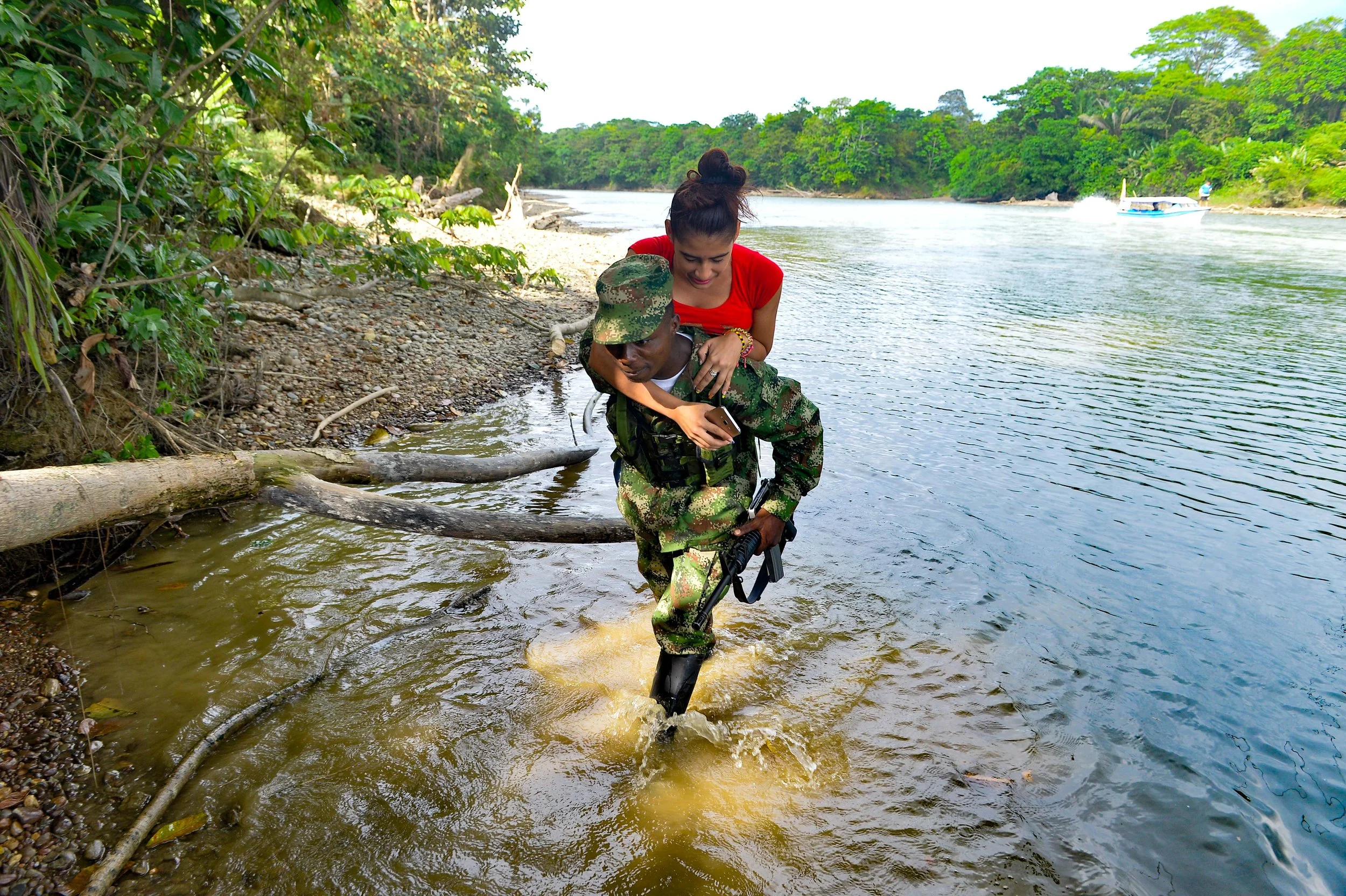
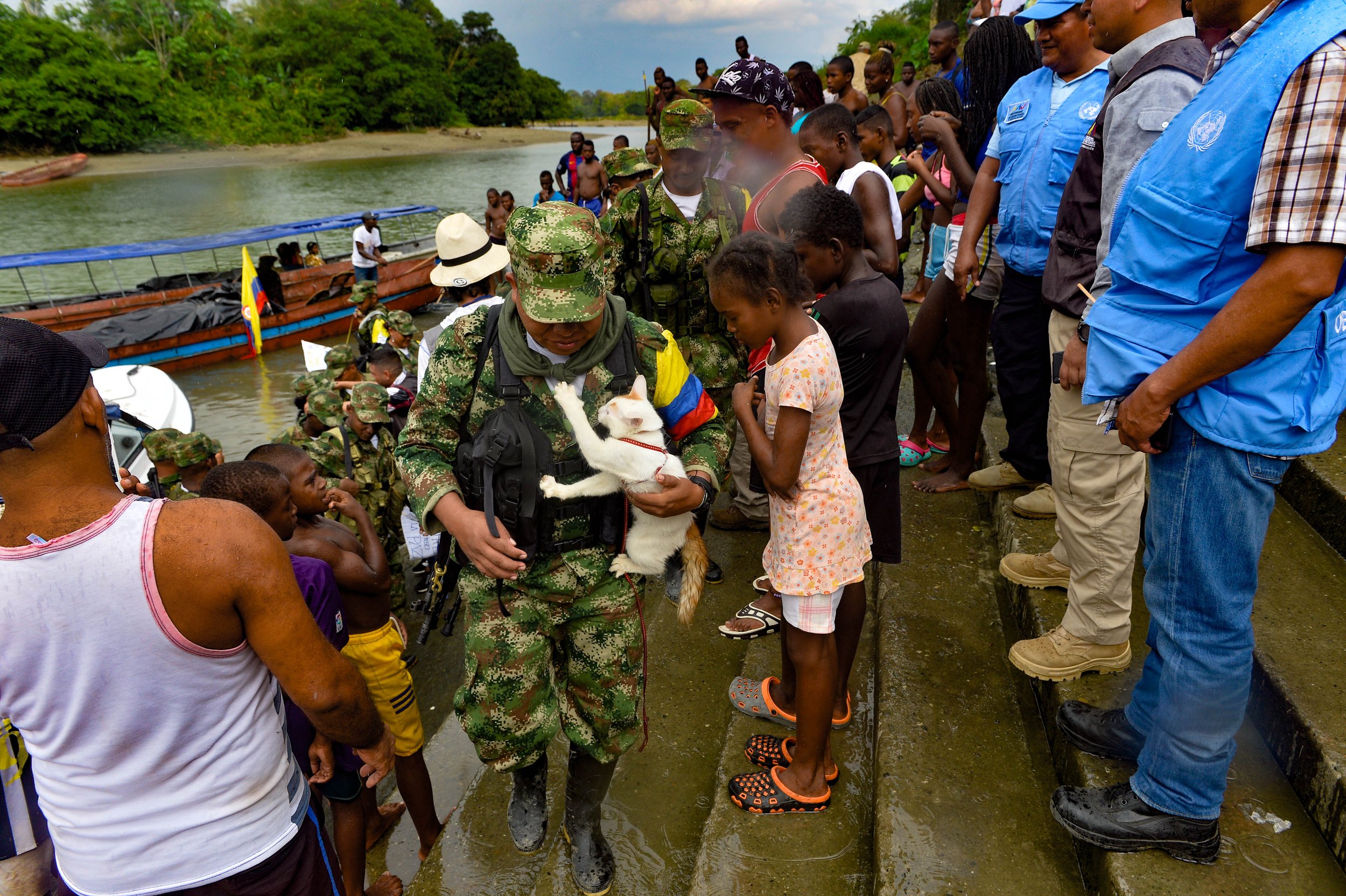
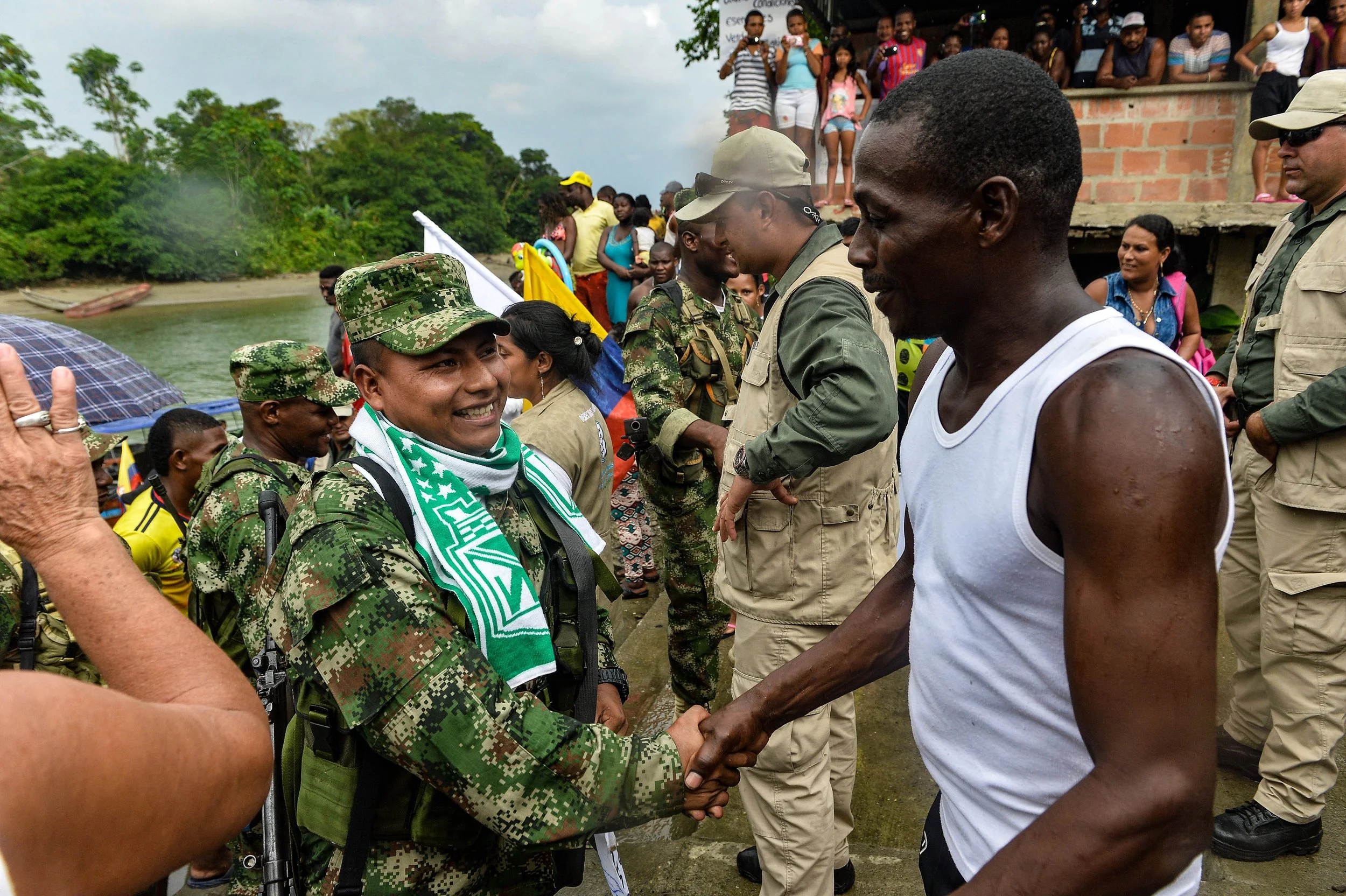
This project documents that threshold. Over 43 days, I traveled through the department of Chocó and toward Bajo Calima, in Valle del Cauca, alongside members of the FARC linked to the Arturo Ruiz unit as they prepared to leave their camps for the zones where they would hand over their weapons. We moved by boat, by bus and by chiva, the brightly painted rural buses of Colombia's countryside, arranging passage through areas where other armed organizations remained active. We slept in jungle tents, lived on limited rations and shared days with communities that had endured the conflict at close range.
The photographs that follow record a passage that lasted only weeks but had been more than fifty years in the making.
Fifty-Two Years of War
The Revolutionary Armed Forces of Colombia, known as the FARC and later as the FARC-EP, for People's Army, was founded in 1964 by peasant fighters in Colombia's interior. It emerged from rural struggles over land and from a political system that excluded much of the countryside. It defined itself as a Marxist-Leninist insurgency aiming to seize state power, and it grew into the country's largest guerrilla army, widely described as the oldest in Latin America.
Over the following decades, the conflict drew in other guerrilla groups, right-wing paramilitary forces, the state's own security forces and drug-trafficking networks. Land disputes merged with the cocaine economy. The FARC financed itself through extortion, the drug trade and kidnapping on a massive scale, while paramilitaries and state agents committed atrocities of their own.
The human cost is difficult to grasp. Colombia's Truth Commission, created by the peace agreement, counted 450,664 people killed between 1985 and 2018, most of them civilians, along with at least 121,768 disappeared and some 7.7 million displaced. Several generations of Colombians had never known a country at peace.
From Havana to the River
The government of President Juan Manuel Santos opened formal negotiations with the FARC in 2012, principally in Havana, with Cuba and Norway acting as guarantors. In October 2016, Colombian voters narrowly rejected the first version of the accord in a referendum. The parties renegotiated, and on November 24, 2016, they signed a revised Final Agreement, which Congress then endorsed. That same year, Santos received the Nobel Peace Prize for his efforts to end the war.
The agreement went beyond disarmament. It addressed rural reform, political participation, illicit drugs and the rights of victims, and it created a transitional justice system to establish truth and accountability for crimes committed by all sides.
Its first visible step was physical. FARC units moved from their camps to temporary pre-grouping points and then to 26 designated sites: 19 transitional rural zones and seven smaller points, where fighters would gather under a bilateral ceasefire. Between January 28 and February 19, 2017, the United Nations verified the land, river and sea movements of 6,934 FARC members along 36 routes, one of the largest logistical operations in the country's history.
These steps are distinct, and the distinction matters. The movement brought fighters to the zones. Concentration kept them there. The laying down of arms, the handover of weapons to UN monitors completed in 2017, ended the FARC as an armed force. Reintegration into civilian, economic and political life is the long process that continues today. This project documents the first of these steps: the journey out.
Forty-Three Days at the Edge of the State
The Arturo Ruiz was a mobile unit of the FARC's Western Bloc, which operated mainly in the southwestern departments of Valle del Cauca and Cauca. Its route out of the war ran through some of Colombia's most isolated terrain: the rainforests and rivers of Chocó and the Pacific basin around Buenaventura, where roads give way to waterways and the state has long been a distant presence.
The journey itself became a lesson in geography. Every stretch of river, every bus route, had to be negotiated with an awareness of who controlled it. The FARC was leaving, but the territory it left behind was not empty. Other armed groups operated along the same corridors, and the boatman's warning about our cameras was a reminder that the peace being signed in Bogotá had not yet reached every bend of the river.
We did not spend those weeks only among fighters. Commander Christian asked us to spend time with the residents of Panamacito, in Chocó. There, and across the surrounding San Juan region, families lived with limited access to essential services, conditions that predated the negotiations by generations. Living alongside them, and alongside people who had suffered the conflict directly, made it impossible to see the FARC's departure as a story about the guerrilla alone. It was also a story about the places the war had passed through, and about who would remain there once the fighters had gone.
Learning to See the Enemy
Armed groups thrive where the state is thin. Where protection is uncertain and opportunity scarce, a promise of income, belonging or purpose carries real weight. Control of territory lets an armed organization back that promise with fear. Political instruction becomes indoctrination when people cannot question it or leave. The Truth Commission documented thousands of children forcibly recruited by guerrilla groups, and the FARC's own leaders now face judicial proceedings over child recruitment.
Yet the communities of the Pacific cannot be understood only through the power exercised over them. Afro-Colombian and Indigenous communities there have their own knowledge, institutions and long traditions of resistance. Living under an armed group's influence is not the same as allegiance to it, and poverty alone does not explain why anyone takes up a rifle.
The same discipline applies to those a country learns to call its enemies. Those who direct wars benefit when the other side appears beyond understanding: a uniform becomes an entire identity, and listening is mistaken for agreement. Spending weeks with members of the column meant resisting that reduction while remaining alert to the limits of what they told us. Their accounts could never replace those of the people the FARC harmed. Understanding a person's circumstances does not settle the question of their responsibility. It allows them to be seen whole, including the uncomfortable possibility that suffering and responsibility for harm can exist within the same life.
Ten Years Later: A Peace Still Being Decided
As of October 2026, the FARC no longer exists as an army. Its former members created a political party, now called Comunes, and the United Nations reports that more than 11,000 former combatants remain in the reintegration process.
Ending a war is not the same as building peace. In Stride Toward Freedom (1958), Martin Luther King Jr. wrote that true peace "is not merely the absence of tension; it is the presence of justice." Colombia's agreement rests on that same idea. Silencing the rifles was only the first step. The harder one was answering to the victims.
Accountability has also advanced. The Special Jurisdiction for Peace, known by its Spanish acronym JEP, is the court created by the agreement to try the gravest crimes of the conflict, committed by guerrillas and state agents alike. Those who acknowledge responsibility and contribute to the truth receive restorative sanctions instead of prison: years of supervised work for victims and communities, with limits on where they can live and travel. Those who do not face trial and up to 20 years behind bars. In 2026, the JEP's appeals chamber confirmed the sentence against the seven members of the FARC's last leadership for more than 21,000 kidnappings. Their eight-year restorative sanctions, monitored electronically, run from August 2026 to February 2034, and began in September with the search for the remains of disappeared people. Many victims' organizations have criticized the absence of prison terms and question whether the former commanders have told the full truth.
The dangers are concrete. According to the UN Secretary-General's latest report, covering June 27 to September 26, 2026, 501 former combatants have been killed since the agreement was signed, 13 of them in 2026. The same report records continued displacement, confinement of communities and the recruitment of children by armed groups, along with delays in rural reform. FARC dissident factions that rejected the agreement remain active, including in Bajo Calima, along the very corridors this project crossed.
The political landscape has shifted as well. President Abelardo de la Espriella, who took office in August 2026 after campaigning against the agreement and the JEP, leads the third government charged with implementing the accord. The UN has noted his administration's stated intention to meet the agreement's constitutional and legal obligations, though its implementation strategy has not yet been detailed. In September 2026, a constitutional amendment was introduced in the Senate to end the JEP's mandate in March 2028 and transfer pending cases to ordinary courts, alongside a proposal to cut its budget. Both are proposals, not law; their passage would require multiple votes in Congress. Former President Santos has called for funding to guarantee the court's work through 2033, the term foreseen under the agreement.
What the Photographs Remember
The photographs that follow do not show how this story ends. They show a beginning: people who had organized their lives around war setting out, under the terms of a negotiated agreement, toward a life that had not yet taken shape. Some of what came after was hopeful. Some of it was violent. None of it is visible in these frames, and I have tried not to ask them to carry more than they recorded.
What they can offer is evidence of a moment that was real. For a few weeks, along rivers and jungle trails that had belonged to the conflict, the movement of armed fighters meant leaving the war rather than waging it. I wanted to document that passage with attention to the people within it and respect for the lives beyond the frame, above all the lives of those who bore the cost of the war.
Ten years after the agreement was signed, Colombia is still deciding what that peace will become. I believe every effort toward peace is the right one, even when it is imperfect and unfinished, because the alternative is always counted in lives. This archive is a reminder of where one of those efforts began, and of the people who chose, along those rivers, to walk away from the war.
Scroll on to see the photographs. This archive is available for exhibition, publication and educational use; to bring it to a gallery, a classroom or a newsroom, get in touch at info@juandavidtena.com.
Text and photographs: Juan David Tena








Sponsored By
-
![Presidency of The Republic of Colombia]()
Presidency of the Republic of Colombia
Special Comission
-
![]()
Compaz Fundation
Special Comission
-
![]()
National Center of Historical Memory of Colombia
Special Comission


