“For what shall it profit a man, if he shall gain the whole world, and lose his own soul?”
— Mark 8:36, King James Version
We Know Who We Are
Mills Gallery
I did not make this exhibition to show Colombia. I made it to remember it.
When you migrate, no one asks you to forget who you are. It happens slowly, almost politely. You soften your accent so the meeting goes better. You shorten your name so it is easier to say. You stop telling the stories from home because no one around you would recognize them. Then one day you notice that your children know more about the country you live in than the one you came from. I have seen this happen in my community, and I know its pull. We Know Who We Are grew out of that fear: that in trying to belong, we erase ourselves.
What hung on these walls
Eighteen photographs brought together the Colombia that rarely appears in headlines or tourism campaigns. Arhuaco Water Teacher. Wisdom of the Amazon Chief. Vivid Paia Hidden in the Colorscape. Full-length portraits of Indigenous people who carry knowledge older than the republic, standing as they are, with nothing to prove. Around them, scenes of village life, Afro-Colombian communities, and families who hold the nation together without ever being named in its official story.
On another wall was a photograph I took in 2016 outside Buckingham Palace, during President Santos’s state visit: Colombian flags beside the Union Jack, a horse guard in formation. For years, as photographer to the Presidency, this was my work. I documented how a country presents itself to the world. Those moments matter. But from behind the camera I kept asking who was missing from the frame. I placed these images in the same room on purpose, so the official face of the nation would have to stand next to its people.
Whispers of the Pacific
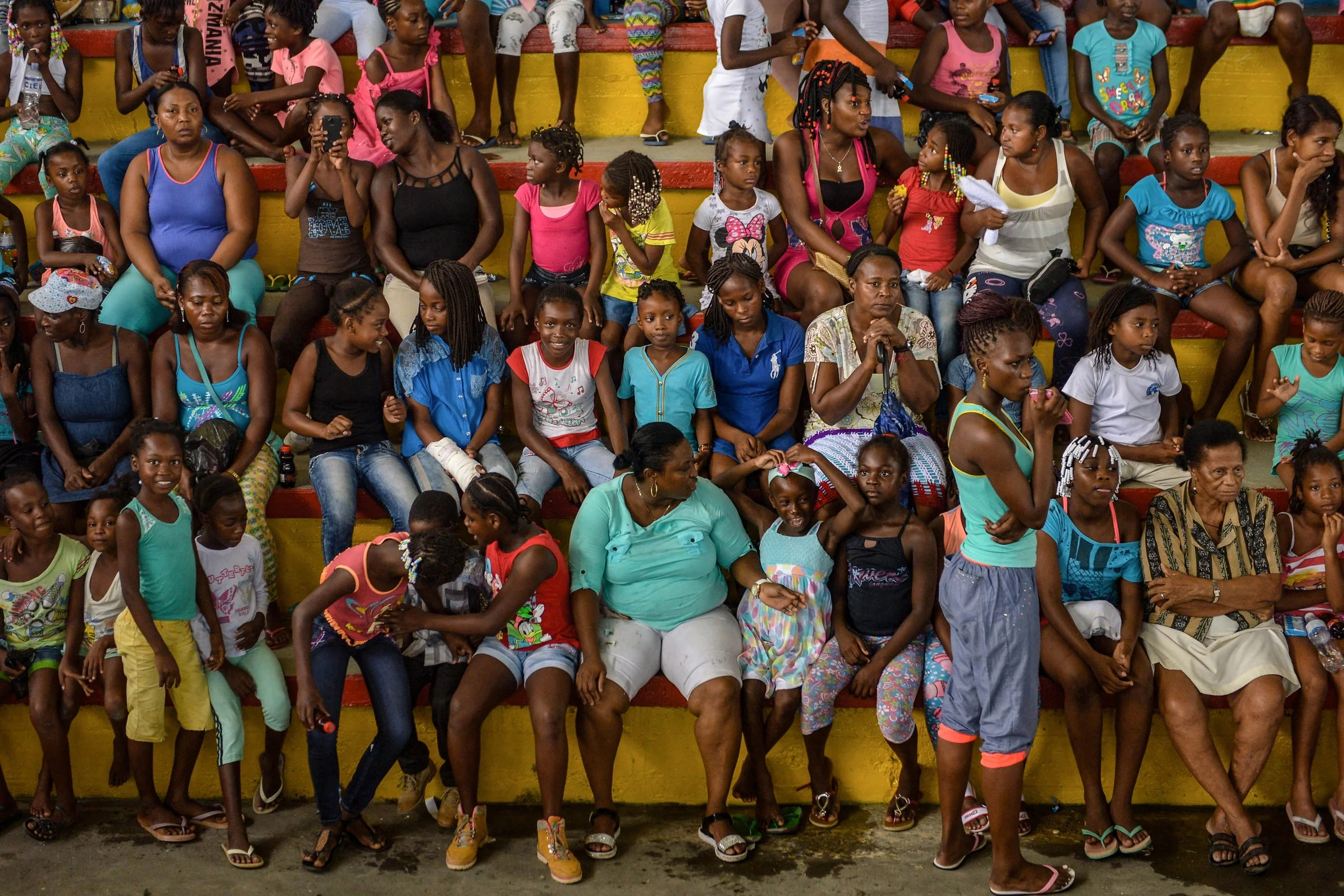
On opening night I walked visitors through each photograph, and the one I always stopped at was Whispers of the Pacific. I made it in Istmina, Chocó, a town that was once a market for enslaved Africans. The people in that image are survivors of a massacre carried out by an armed group. Some of the children are laughing, pushing each other on the bleachers. Most of the adults are not. You can see in their faces what violence leaves behind. Writing about the exhibition in Orlando Weekly, Richard Reep described the work as moving “from the majestic to the horrific.” That is Colombia. The beauty and the wound live in the same place, and I refuse to show one without the other.
The moral question
Every government decides, through its words and its silences, whose lives are visible. Today, in many places, including here in Orlando, where I live, immigrants have become a political argument. We are counted, debated, feared or defended, but rarely seen as people with a history, a family, a faith and a name. When a human being becomes a symbol, it becomes easier to ignore their dignity. I believe the first moral duty of any government is to see the person before the policy. These photographs are my attempt to put the person back in the frame.
I also want to be honest about our own part. Not all erasure is imposed on us. Sometimes we do it ourselves, out of fear, out of exhaustion, out of a deep wish to be accepted. I understand that wish. But a culture that is hidden for long enough does not wait for us. It fades.
The strength we carry
The resilience of our Latin American peoples is not a slogan for me. I see it in communities that kept their languages through centuries of pressure, in the families of Istmina who still found a way to gather, in mothers who started over with nothing and raised children with dignity. That strength runs in our blood. It crossed the border with us. It lives here in Orlando, whether we speak of it or not.
And resilience should never become an excuse. Our peoples should not have to be strong because others failed them. Honoring that strength must never mean forgetting what caused the wound.
What the exhibition became
Ten of the eighteen photographs found a home, seven of them on opening night, and more than $2,000 went to nonprofit organizations in Colombia, including Poca Lana, which works with children in Bogotá. For me, that was the most meaningful part. In some small way, the images returned to the places where they began.
The exhibition was presented by Juan Pablo Santa Luna at Mills Gallery, with the support of the Consulate General of Colombia in Orlando and Colombia’s Ministry of Foreign Affairs. It was also the beginning of a longer conversation with this city. In 2025, that path led me to the Orlando Museum of Art with Portraits of FusionFest, covered by the Orlando Sentinel, where I turned the same question toward the many cultures that now call Central Florida home.
Why this title
We Know Who We Are is a reminder, to our community and to myself, that we can adapt without disappearing. We can learn a new language without losing our own. We can build a home here and still bring something valuable from there: the way we care for each other, our faith, our music, our memory.
Migrating should never mean arriving empty. We bring our essence with us. It is the best thing we have to offer.
text: Juan David Tena


Sponsored By
-
![]()
Government of Colombia
-
![]()
Mills Gallery
-
![]()
Juan Pablo Santa Luna
-
![]()
Colombia Nos Une
-
![]()
Consulado of Colombia in Orlando